Open Electromagnetic Waveguides

2.6: Scalar Wave Equation

2.6 Scalar Wave Equation

The problem of finding the electromagnetic field in a source-free, homogeneous, region is solved once general solutions to the scalar Helmholtz equation are known. These solutions are generally obtained by the method called separation of variables. It has been shown by Eisenhart, [8], that the Helmholtz equation is separable in 11 three-dimensional orthogonal coordinate systems. In the next Sections we will use the separation of variables to solve the Helmholtz equation in the rectangular, circular and elliptical cylindrical, spherical coordinate systems; the reader is referred to [27] for solutions of the wave equations in other coordinate systems. Emphasis is placed on the fact that when the domain of a variable is finite we have a discrete spectrum of eigenvalues and eigenfunctions; while for an unbounded (infinite) domain the discrete spectrum coalesces into a continuum. Another feature which deserves some attention is that, depending on the chosen coordinate system, we can represent the field in our domain in several different ways.

2.6.1 Plane Wave Expansion

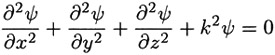
The Helmholtz equation in a rectangular coordinate system is [13],

(2.227)

The method of separation of variables seeks solutions of (2.227) in the form

(2.228)

By introducing (2.228) into (2.227) and by dividing by ? we get

(2.229)

In (2.229) each term depends on only one coordinate. The various terms depending on the x, y, z coordinates are linked only via k 2. Thus, by separating k 2 into three constants k x , k y, k

UNLIMITED FREE
ACCESS
TO THE WORLD'S BEST IDEAS

SUBMIT
Already a GlobalSpec user? Log in.

This is embarrasing...

An error occurred while processing the form. Please try again in a few minutes.

Customize Your GlobalSpec Experience

Category: CMM, Gage, and Inspection Equipment Services
Finish!
Privacy Policy

This is embarrasing...

An error occurred while processing the form. Please try again in a few minutes.