Open Electromagnetic Waveguides

2.5: Potentials

2.5 Potentials

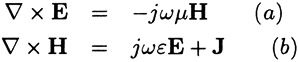
The main difficulty posed by electromagnetic problems is the solution of Maxwell's equations with appropriate boundary conditions. In a homogeneous region the two curl equations

(2.171)

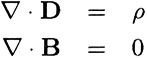
provide six scalar equations to be solved in order to find electric and magnetic fields. The divergence equations for the fields

(2.172)

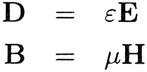
must be simultaneously satisfied while also the constitutive relations

(2.173)

hold. For the purpose of avoiding the solution of such a large set of equations, it is generally useful to introduce some potential functions in terms of which the electromagnetic fields can be expressed. The first potentials we consider are the vector and scalar potential functions A and ? which represent an extension of the static magnetic vector potential and electrical scalar potential, respectively. Potential theory is generally developed considering the time-dependent form of Maxwell's equations [33, 17, 2]; since we are primarily concerned with time-harmonic fields, we will consider directly time-harmonic potentials. In this case, an exp( j ?t) timedependence is assumed and suppressed. By taking the divergence of (2.171a) we see that

(2.174)

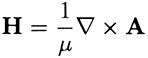
i.e. the divergence equation for H is automatically satisfied. Also, this fact make it possible to express H as

(2.175)

where A is called the magnetic vector potential. In general the vector A has both a lamellar part ( ? . A ? 0) and a solenoidal part ( ? x A ? 0). By using (2.175) we have imposed a condition on...

UNLIMITED FREE
ACCESS
TO THE WORLD'S BEST IDEAS

SUBMIT
Already a GlobalSpec user? Log in.

This is embarrasing...

An error occurred while processing the form. Please try again in a few minutes.

Customize Your GlobalSpec Experience

Category: Finite-difference time-domain (FDTD) Software
Finish!
Privacy Policy

This is embarrasing...

An error occurred while processing the form. Please try again in a few minutes.