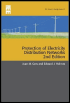
Protection of Electricity Distribution Networks, 2nd Edition
A protection relay is a device that senses any change in the signal it is receiving, usually from a current and/or voltage source. If the magnitude of the incoming signal is outside a pre-set value the relay will carry out a specific operation, generally to close or open electrical contacts to initiate some further operation, for example the tripping of a circuit breaker.
Protection relays can be classified in accordance with their construction, the incoming signal and function.
electromechanical
solid state
microprocessor
numerical
non-electric (thermal, pressure, etc.)
current
voltage
power
frequency
temperature
pressure
speed
others
overcurrent
directional overcurrent
distance
overvoltage
differential
reverse power
others
The international classification for the more common relays, which is used in the following chapters, is given below:
| 21 | distance relay |
| 24 | volts/hertz |
| 25 | synchronising or synchronism-check device |
| 26 | thermal device |
| 27 | undervoltage relay |
| 32 | reverse-power relay |
| 37 | under-current or under-power relay |
| 40 | relay for field excitation |
| 41 | field circuit breaker |
| 43 | manual transfer or selector device |
| 46 | negative-sequence current relay |
| 47 | negative-sequence voltage relay |
| 49 | thermal relay |
| 50 | instantaneous overcurrent relay |
| 51 | time-delay overcurrent relay |
| 52 | circuit breaker |
| 55 | power factor relay |
| 59 | overvoltage relay |
| 60 | voltage or current balance relay |
| 62 | time-delay relay |
| 63 | pressure relay, for flow or level of liquid or gases |
| 64 | earth protection relay |
| 67 | directional overcurrent relay |
| 68 | blocking relay |
| 74 | alarm relay |
| 78 | out-of-step relay |
| 79 | reclosing relay |
| 81 | frequency relay |
| 85 |