Protection of Electricity Distribution Networks, 2nd Edition
Chapter 13: Processing Alarms

13.1 General

The various protection schemes described in earlier chapters in this book are provided to disconnect faults on power systems promptly, with the minimum of disruption to the network and to customers. Alarms are triggered by the operation of the protection relays and send coded information to distribution control centres so that the control room operators are aware of what is happening on the network. Other alarms indicate the state of the power system, for example voltages at various locations and load flows on the more important circuits.

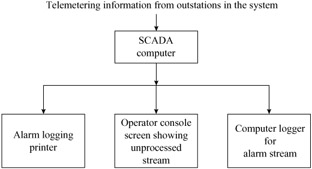
These alarms provide one of the main sources of information flowing in real-time into a distribution control centre and are normally channelled to one printer in the control room where a hard copy can be produced. The alarm streams are also channelled to the operator's or control engineer's console where they can be displayed on computer screens. A third avenue for alarm streams is for them to be stored in a data logger where the principle function is to retain a history of the alarm streams, which can be used for post-system fault analysis if a serious fault occurs in a system and it is thought necessary to carry out such an analysis (see Figure 13.1).


Figure 13.1: Alarm streaming

It is worth nothing that, with this arrangement, the alarms are not processed. Several events may occur simultaneously, or at a close time proximity with respect to each other, and each incident may trigger many alarms resulting in a large number...

UNLIMITED FREE
ACCESS
TO THE WORLD'S BEST IDEAS

SUBMIT
Already a GlobalSpec user? Log in.

This is embarrasing...

An error occurred while processing the form. Please try again in a few minutes.

Customize Your GlobalSpec Experience

Category: Audible Alarms
Finish!
Privacy Policy

This is embarrasing...

An error occurred while processing the form. Please try again in a few minutes.