Protection of Electricity Distribution Networks, 2nd Edition
Faults close to generator terminals may result in voltage drop and fault current reduction, especially if the generators are isolated and the faults are severe. Therefore, in generation protection it is important to have voltage control on the overcurrent time-delay units to ensure proper operation and co-ordination. These devices are used to improve the reliability of the relay by ensuring that it operates before the generator current becomes too low. There are two types of overcurrent relays with this feature -voltage-controlled and voltage-restrained, which are generally referred to as type 51V relays.
The voltage-controlled (51/27C) feature allows the relays to be set below rated current, and operation is blocked until the voltage falls well below normal voltage. The voltage-controlled approach typically inhibits operation until the voltage drops below a pre-set value. It should be set to function below about 80 percent of rated voltage with a current pick-up of about 50 percent of generator rated current.
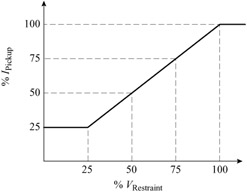
The voltage-restrained (51/27R) feature causes the pick-up to decrease with reducing voltage, as shown in Figure 5.23. For example, the relay can be set for 175 percent of generator rated current with rated voltage applied. At 25 percent voltage the relay picks up at 25 percent of the relay setting (1.75 0.25 = 0.44 times rated). The varying pick-up level makes it more difficult to co-ordinate the relay with other fixed pick-up overcurrent relays.
Since the voltage-controlled type has a...