Protection of Electricity Distribution Networks, 2nd Edition
This section presents several examples of logic scheme customisation to provide functions that normally are not incorporated in numerical relays as part of a manufacturer's package. Topology changes, for example, affect the short-circuit levels and therefore an incorrect co-ordination might arise if the relays are not reset for the prevailing power system conditions. To overcome this, adaptive protection, which can be implemented by using the multiple setting groups feature included in most numerical relays, is essential.
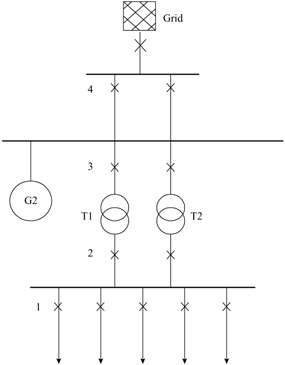
Figure 5.26 shows a portion of a power system that might have four scenarios as follows:
system normal;
one of the transformers out of service for maintenance;
the grid infeed not available;
the in-house generator out of service.
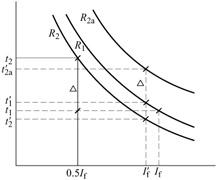
For a fault on one of the feeders, resulting in a fault current of I f, from the co-ordination curve R 1 in Figure 5.27 the feeder relay would operate in a time t 1. With both transformers in service the fault current passing through each transformer would be 0.5 If. The relay R 2 on the low voltage side of the transformer would then operate in time t 2, giving a discrimination margin of ( t 2 - t 1).
However, when one transformer is out of service, the current through the remaining transformer increases to
. From curve R 2, the transformer...