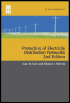
Protection of Electricity Distribution Networks, 2nd Edition
Previous chapters have detailed the make up and operating characteristics of various types of protection relays. This chapter considers the combination of relays required to protect various items of power system equipment, plus a brief reference to the diagrams that are part of substation design work. A general knowledge of these diagrams is important in understanding the background to relay applications.
It is difficult to define precisely the protection schemes that should be adopted for an electricity distribution system, given the large number of valid alternatives for each situation, but some schemes will be presented as a guide for protecting the various elements that make up a power system. However, any protection scheme should strike a balance between the technical and economic aspects so that, for example, sophisticated protection devices are not used for small machines or for less important power system elements.
Generator protection should take into account the importance of the generator and its technical characteristics such as power, voltage and earthing arrangement, plus any economic considerations. A complex protection scheme can ensure that the generator is protected against whatever faults may occur. However, it is unlikely that such a cost could be justified for every generating station, especially those with small units. It is, therefore, necessary to define a protection scheme that is adequate for the size of the machine.
Two generator protection schemes are given below, based on suggestions by manufacturing companies.
For small generators, typically up to...