Radar Techniques Using Array Antennas

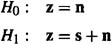
The fundamental problem for statistical decision theory when applied to radar is the detection of a signal out of noise and interference. We measure the received signal vector z. This may be composed of a target echo signal vector s and noise vector n or only noise alone. We define the two hypotheses:
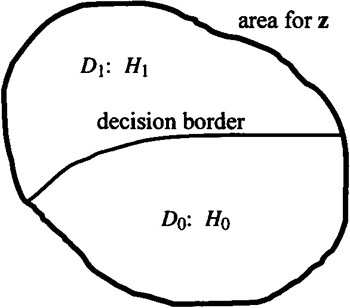
We want to make our decision for H 0 or H 1 based on the measured z. In other words. we have to divide the set of possible realisations for z into two regions D 0 and D 1, one for H 0 and one for H 1 (see Figure 3.9). If we measure z in region D 0 we accept H 0 and for z in D 1 we accept H 1. The problem now is to find the borderline between D 0 and D 1. We now define decision rules, following e.g. Middleton [3]:
If z is in D 1 then we express the decision for H 1 by:
If z is in D 0 then we express the decision for H 0 by:
We always have for all z:
We assume as known the conditional probability densities p( z/0) and p( z/ s) according to the hypotheses H 0 and H 1