Radar Techniques Using Array Antennas

Chapter 15: Inverse Synthetic Aperture Radar (ISAR)

15.1 Introduction: basic principles

In chapter 14 we have seen high-resolution images of the ground scene produced by a radar flying on an elevated platform and thereby forming a long synthetic aperture. This long aperture resulted in a very fine azimuth or cross-range resolution. For ground-based radar systems it is often also highly desirable to get images of detected targets, for example of the observed aircraft. This could be a valuable contribution to a classification of flying targets.

Early ideas on this topic have emerged in the open literature since 1969: Brown and Fredricks [1] gave a discussion on range Doppler imaging and Kock [2] suggested an improved gain for a ground radar by a synthetic aperture beam for detecting and perhaps resolving aircraft. The author [3] presented in 1973 radar experiments with aircraft targets which demonstrated the feasibility of target imaging in one dimension (cross range). Then followed several publications discussing the method more comprehensively and presenting further experimental results, even for two-dimensional images [4 ?7].

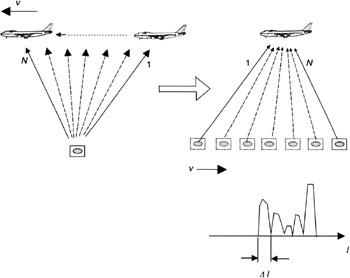
The generation of a radar target images may be confined to targets which are already detected, acquisitioned and tracked by our multifunction radar. Then it is possible to transmit to a selected flying target a suitable pulse series, using beam agility and the tracking capability of a phased-array radar. The basic idea is explained in Figure 15.1.


Figure 15.1: asic principle for inverse synthetic aperture (ISAR)

The radar transmits a regular pulse series to the target and echoes are received and written...

UNLIMITED FREE
ACCESS
TO THE WORLD'S BEST IDEAS

SUBMIT
Already a GlobalSpec user? Log in.

This is embarrasing...

An error occurred while processing the form. Please try again in a few minutes.

Customize Your GlobalSpec Experience

Category: Aviation Transponders
Finish!
Privacy Policy

This is embarrasing...

An error occurred while processing the form. Please try again in a few minutes.