Radar Techniques Using Array Antennas

After the detection of a target follows the determination of its parameters, for example the mean and variance of its amplitude, Doppler frequency shift, azimuth and elevation angle.
For the signal z we assume as known the probability density function, which depends on a parameter set ?, that is p( z) = p( z; ?).
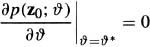
For a measured signal z 0, inserted in p( z; ?), we get a function of ? only. The estimate ?* is determined by maximising p( z 0; ?) with respect to ?. This maximum is found as usual by setting the first derivative with respect to ? to zero:
or equivalently:
This equation determines for the measured signal that estimate ?* with the highest probability.
For example, if ? is the target direction, we have to maximise p( z 0; ?) by varying the assumed direction. This application will be discussed in detail within chapter 11. The corresponding estimation of Doppler frequency is treated in chapter 8.
An estimate
will be a random variable with a certain variance, given by equation 3.33, because of the noise component of the received and measured signal z. Under noise we may understand also measurement errors. It is possible to determine the minimal achievable variance for the estimated parameter.
We will give,...