Radar Techniques Using Array Antennas

At the output of beamforming and the receiver channel, with a bandpass filter at the intermediate frequency IF, the received signals are available for further processing. They are at this stage continuous analogue signals. For digital processing we need sampled values of the orthogonal components I and Q as described in chapter 2 with equation 2.1. In this chapter we will discuss the necessary sampling rate and methods to derive the orthogonal components I and Q.
For the interested readers and for completeness we start here with an explanation of the term analytical signal. This material is discussed in more detail within several text books, e.g. Reference 1.
A real signal at the frequency ? 0 may be represented by:
In the case of radar systems we have a narrow bandwidth. That means a( t) is slowly varying compared to the carrier frequency ? 0.
To this real signal corresponds a spectrum F( j?) given by the Fourier transform:
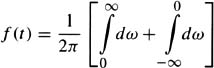
The integral may be partitioned with respect to the integration limits into the form:
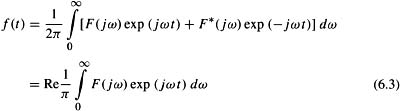
and by using F*( j?) = F( ? j?) to achieve a real signal f( t) with equation 6.1 we get:
This may be written:
The complex signal f +( t) is named analytical. It is composed of:
We have to add to the original real signal f( t) an orthogonal or imaginary part