Radar Techniques Using Array Antennas

Chapter 13: Space-Time Adaptive Processing

13.1 Introduction

For a radar onboard a flying platform (aircraft, drone, satellite) the direction dependent relative velocities of the ground scatterers cause corresponding Doppler frequency shifts of the clutter echoes. Against this broadened clutter spectrum one can apply no common filter, because one would thereby suppress too broad a Doppler frequency range of possible targets and would thus limit target detection inadmissibly and unnecessarily. With an active receiving antenna array, however, a signal field with samples in the space and time dimension can be offered for optimal signal processing for the detection of moving targets [1 7], even if those targets are slowly moving. The antenna array elements may form a linear or a planar array. The antenna can be looking with its broadside orientation forward or sideways relative to the flight direction. For an onboard multifunction phased-array radar, the forward-looking case is particularly of interest [5 8].

13.2 Doppler-shifted clutter spectrum

The clutter Doppler frequency shift depends on the platform velocity v, wavelength ? and the angle ? between the direction to the clutter scatterer and the flight velocity vector [8]:


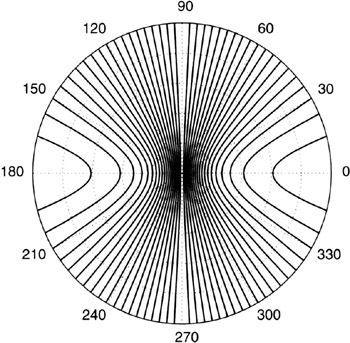
On a cone with its axis given by the flight velocity vector the Doppler frequency shift is constant, its value depends only on the angle ?. The intersection of the cone with the flat ground plane is a hyperbola and on this curve we have a constant Doppler frequency. All curves with constant Doppler shifts are given by the set of hyperbolas as illustrated in Figure 13.1.


Figure 13.1:

UNLIMITED FREE
ACCESS
TO THE WORLD'S BEST IDEAS

SUBMIT
Already a GlobalSpec user? Log in.

This is embarrasing...

An error occurred while processing the form. Please try again in a few minutes.

Customize Your GlobalSpec Experience

Category: Speed Logs
Finish!
Privacy Policy

This is embarrasing...

An error occurred while processing the form. Please try again in a few minutes.