Radar Techniques Using Array Antennas

Chapter 5: Beamforming

Overview

Beamforming with all antenna elements of an array for transmitting or receiving means reproducing a desired beam pattern as closely as possible. Generally, a narrow main beam with high gain at the centre in the desired direction combined with low sidelobes for all other directions is required. The fundamental procedure for beamforming is, as described in chapter 4 section 4.2.5, weighting the individual signals of all antenna elements and then summing all these weighted signals.

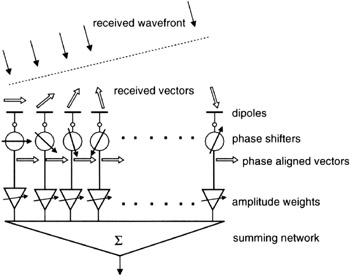
By phase steering or phase rotation the complex target echoes from all antenna elements are aligned in phase for the desired direction to produce a maximum sum signal, as shown in Figure 5.1. Then, according to example 5 in chapter 3 (detection of a known signal) and illustrated in Figure 3.10, the maximum signal-to-noise ratio is achieved for target echoes from the desired directions. This procedure therefore optimises target detection out of noise.


Figure 5.1: Basic principle of beamforming: phase alignment, amplitude weighting (tapering) and summing

The phase rotations are usually provided by microwave phase shifters. In principle, phase shifting may also be achieved by multiplying the received signal with a corresponding complex number. The signal of each antenna element then has first to be converted down to the baseband and analogue-to-digital converted. The signal is then represented by its orthogonal components as given in chapter 2 equation 2.1. For all N antenna elements we get the signals:


With back rotation of the phase n ? for element n and summing...

UNLIMITED FREE
ACCESS
TO THE WORLD'S BEST IDEAS

SUBMIT
Already a GlobalSpec user? Log in.

This is embarrasing...

An error occurred while processing the form. Please try again in a few minutes.

Customize Your GlobalSpec Experience

Category: Beam Steerers
Finish!
Privacy Policy

This is embarrasing...

An error occurred while processing the form. Please try again in a few minutes.