Real-Time Concepts for Embedded Systems
Multiple concurrent threads of execution within an application must be able to synchronize their execution and coordinate mutually exclusive access to shared resources. To address these requirements, RTOS kernels provide a semaphore object and associated semaphore management services.
This chapter discusses the following:
defining a semaphore,
typical semaphore operations, and
common semaphore use.
A semaphore (sometimes called a semaphore token) is a kernel object that one or more threads of execution can acquire or release for the purposes of synchronization or mutual exclusion.
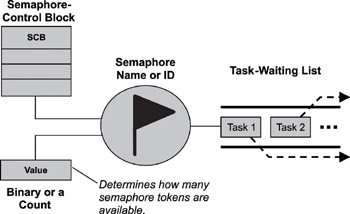
When a semaphore is first created, the kernel assigns to it an associated semaphore control block (SCB), a unique ID, a value (binary or a count), and a task-waiting list, as shown in Figure 6.1.
A semaphore is like a key that allows a task to carry out some operation or to access a resource. If the task can acquire the semaphore, it can carry out the intended operation or access the resource. A single semaphore can be acquired a finite number of times. In this sense, acquiring a semaphore is like acquiring the duplicate of a key from an apartment manager when the apartment manager runs out of duplicates, the manager can give out no more keys. Likewise, when a semaphore s limit is reached, it can no longer be acquired until someone gives a key back or releases the semaphore.
The kernel tracks the number of times a semaphore...