Real-Time Concepts for Embedded Systems
In addition to the key kernel objects, such as tasks, semaphores, and message queues, kernels provide many other important objects as well. Because every kernel is different, the number of objects a given kernel supports can vary from one to another. This chapter explores additional kernel objects common to embedded systems development, although the list presented here is certainly not all-inclusive. Specifically, this chapter focuses on:
other kernel objects, including pipes, event registers, signals, and condition variables,
object definitions and general descriptions,
associated operations, and
typical applications of each.
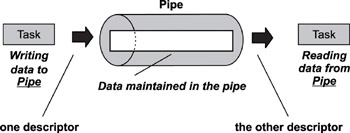
Pipes are kernel objects that provide unstructured data exchange and facilitate synchronization among tasks. In a traditional implementation, a pipe is a unidirectional data exchange facility, as shown in Figure 8.1. Two descriptors, one for each end of the pipe (one end for reading and one for writing), are returned when the pipe is created. Data is written via one descriptor and read via the other. The data remains in the pipe as an unstructured byte stream. Data is read from the pipe in FIFO order.
A pipe provides a simple data flow facility so that the reader becomes blocked when the pipe is empty, and the writer becomes blocked when the pipe is full. Typically, a pipe is used to exchange data between a data-producing task and a data-consuming task, as shown in Figure 8.2. It is also permissible to have several writers for the pipe with multiple readers on it.