Real-Time Concepts for Embedded Systems

This section presents more complex design patterns for synchronization and communication. Multiple synchronization primitives can be found in a single design pattern.
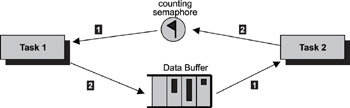
Task-to-task communication commonly involves data transfer. One task is a producer, and the other is a data consumer. Data processing takes time, and the consumer task might not be able to consume the data as fast as the producer can produce it. The producer can potentially overflow the communication channel if a higher priority task preempts the consumer task. Therefore, the consumer task might need to control the rate at which the producer task generates the data. This process is accomplished through a counting semaphore, as shown in Figure 15.17. In this case, the counting semaphore is a permission to produce data.
The data buffer in this design pattern is different from an RTOS-supplied message queue. Typically, a message queue has a built-in flow control mechanism. Assume that this message buffer is a custom data transfer mechanism that is not supplied by the RTOS.
As shown in Figure 15.17, task #1 is the data producer, while task #2 is the consumer. Task #1 can introduce data into the buffer as long as the task can successfully acquire the counting semaphore. The counting semaphore may be initialized to a value less than the maximum allowable token value. Task #2 can increase the token value with the give operation and...