Real-Time Concepts for Embedded Systems

Synchronization is classified into two categories: resource synchronization and activity synchronization . Resource synchronization determines whether access to a shared resource is safe, and, if not, when it will be safe. Activity synchronization determines whether the execution of a multithreaded program has reached a certain state and, if it hasn t, how to wait for and be notified when this state is reached.
Access by multiple tasks must be synchronized to maintain the integrity of a shared resource. This process is called resource synchronization , a term closely associated with critical sections and mutual exclusions.
Mutual exclusion is a provision by which only one task at a time can access a shared resource. A critical section is the section of code from which the shared resource is accessed.
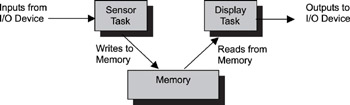
As an example, consider two tasks trying to access shared memory. One task (the sensor task) periodically receives data from a sensor and writes the data to shared memory. Meanwhile, a second task (the display task) periodically reads from shared memory and sends the data to a display. The common design pattern of using shared memory is illustrated in Figure 15.1.
Problems arise if access to the shared memory is not exclusive, and multiple tasks can simultaneously access it. For example, if the sensor task has not completed writing data to the shared memory area before the display task tries to display the data, the display would contain a mixture...