Real-Time Concepts for Embedded Systems
A good real-time embedded operating system avoids implementing the kernel as a large, monolithic program. The kernel is developed instead as a micro-kernel. The goal of the micro-kernel design approach is to reduce essential kernel services into a small set and to provide a framework in which other optional kernel services can be implemented as independent modules. These modules can be placed outside the kernel. Some of these modules are part of special server tasks. This structured approach makes it possible to extend the kernel by adding additional services or to modify existing services without affecting users. This level of implementation flexibility is highly desirable. The resulting benefit is increased system configurability because each embedded application requires a specific set of system services with respect to its characteristics. This combination can be quite different from application to application.
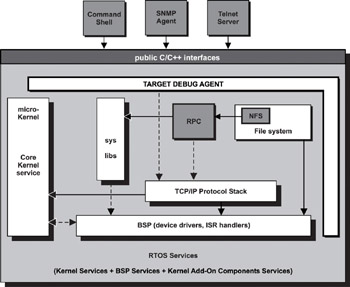
The micro-kernel provides core services, including task-related services, the scheduler service, and synchronization primitives. This chapter discusses other common building blocks, as shown in Figure 9.1.
These other common building blocks make up the additional kernel services that are part of various embedded applications. The other building blocks include the following:
TCP/IP protocol stack,
file system component,
remote procedure call component,
command shell,
target debut agent, and
other components.
The network protocol stacks and components, as illustrated in Figure 9.2, provide useful system services to an embedded application in a networked environment. The TCP/IP protocol stack provides transport...