Satellite Communications Systems, 3rd Edition
An updated and revised reference which explains the design and planning of systems, as well as some history and background on the subject.
 TABLE OF CONTENTS
 P.T. Thompson
A number of factors resulting from changes in the atmosphere have to be taken into account when designing a satellite communications system in order to avoid impairment of the wanted signal. Generally, a margin in the required carrier-to-noise ratio is incorporated to accommodate such effects.
Radio noise emitted by matter is used as a source of information in radioastronomy and in remote sensing. Noise of a thermal origin has a continuous spectrum, but several other radiation mechanisms cause the emission to have a spectral-line structure. Atoms and molecules are distinguished by their different spectral lines.
For other services such as satellite communications noise is a limiting factor for the receiving system; generally, it is inappropriate to use receiving systems with noise temperatures which are much less than those specified by the minimum external noise.
From about 30 MHz to about 1 GHz cosmic noise predominates over atmospheric noise except during local thunderstorms, but will generally be exceeded by man-made noise in populated areas. Above 1 GHz, the absorptive constituents of the atmosphere (water vapour, oxygen, hydrometeors) also act as noise sources.
In the bands of strong gaseous absorption, the noise temperature reaches maximum values of some 290 K. At times, precipitation will also increase the noise temperature at frequencies above 5 GHz.
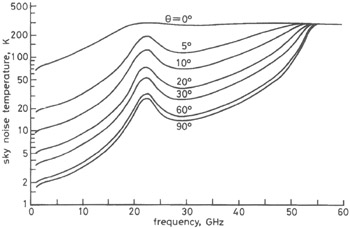
Figure 6.1 gives an indication of sky noise at various elevation angles and frequencies.
The sun is...