Satellite Communications Systems, 3rd Edition
An updated and revised reference which explains the design and planning of systems, as well as some history and background on the subject.
 TABLE OF CONTENTS
 For the satellite medium there are two main methods of accessing and sharing the capacity of the transponders frequency-division multiple access (FDMA) and time-division multiple access (TDMA) both of which are well known. In addition, the combination of several signals can be done on a frequency-division multiplex (FDM) basis, where different carriers are used with defined spectrum capacity for each signal (often called single-channel-per-carrier or SCPC) or a time-division-multiplex (TDM) approach can be adopted where a single carrier is modulated by a single signal comprising the several signals in a digital multiplex (see Figure 18.26). TDMA is an emerging contender for applications in broadcasting in conjuction with on-board processing.
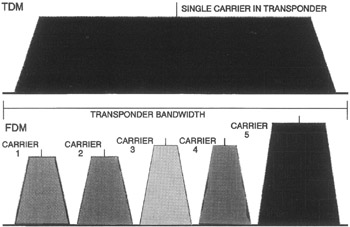
The FDM/FDMA approach has advantages in broadcasting applications where point-to-point transmission is required; for contribution and distribution where several simultaneous transmissions are needed, perhaps only for short periods, with only a few channels at a time, FDMA techniques are sufficient and appropriate, working with partial transponder bandwidths as required. Clearly in this case, which is a point-to-point application, several carriers at various power levels may exist in any transponder at one time; this is illustrated by Figure 18.27 and discussed further below.
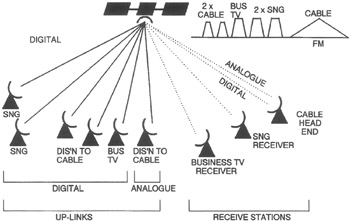
In this application, particular attention has to be paid to the power budget and the intermodulation noise, since the satellite power is shared among several carriers, and to the practical factors such as the receiver mixer phase-noise...