Satellite Communications Systems, 3rd Edition
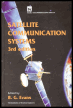
An updated and revised reference which explains the design and planning of systems, as well as some history and background on the subject.
 TABLE OF CONTENTS
 T. Tozer
A satellite communication system will have a number of users operating via a common satellite transponder, and this calls for sharing of the resources of power, bandwidth and time. Here we describe these techniques and examine their implications, with emphasis on principles rather than detailed structure or parameters of particular networks, which tend to be very system specific.
The term used for such sharing and management of a number of different channels is multiple access. Each resource is limited, and ultimately relates to cost or revenue; their efficient use is important, as is meeting the needs of the users' traffic demands.
There are four fundamental techniques of multiple access:
frequency-division multiple access (FDMA);
time-division multiple access (TDMA);
code-division multiple access (CDMA);
packet (or random) access.
Each technique has its advantages and disadvantages, and in practice hybrid schemes are likely to be employed, having features of each. It should also be appreciated that a satellite transponder may be serving more than one network simultaneously, together with a variety of modulation schemes, signal powers and characteristics.
An outline description of spread spectrum is also included here as a modulation technique allowing multiple access capability in the form of CDMA.
A group of satellite terminals may be regarded as constituting a network, and the arrangement of their communication links as the network architecture or configuration. The architecture of a satellite communication network is different from most terrestrial networks, as it has all its links passing through...