Satellite Communications Systems, 3rd Edition
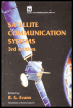
An updated and revised reference which explains the design and planning of systems, as well as some history and background on the subject.
 TABLE OF CONTENTS
 T.G. Jeans
If we have some message or information signal to transmit over a distance without using a cable, electrical or optical fibre, then we need to use a radio-frequency signal to radiate the information. Suppose we have a digital message to send, i.e. a message which is just a sequence of binary digits, 0s and 1s. We could connect this signal to a piece of wire, and some of the signal would radiate into space as an electromagnetic wave. In principle, that electromagnetic wave would induce a voltage on a corresponding piece of wire some distance away and, after (much) amplification, a replica of the signal, contaminated by noise and other interference, could be recovered.
Unfortunately, the efficiency of a piece of wire in radiating a signal is related to the length of the wire compared to the wavelength of the electromagnetic wave being radiated. Since the product of the frequency and wavelength of an EM wave in free space equates to 3 10 8 m/s, if we assume that we have a data rate of say 9600 bits (binary digits) per second, which could be filtered to a bandwidth of 4800 Hz, then this highest frequency component would have a wavelength of 62 500 m. Typical wire antennas radiate effectively when their dimensions are comparable with half the wavelength, which in this example would be 31 250 m, or 31 km. Now, although frequencies as low as 10 kHz or less are used to...