Satellite Communications Systems, 3rd Edition
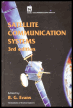
An updated and revised reference which explains the design and planning of systems, as well as some history and background on the subject.
 TABLE OF CONTENTS
 Before proceeding towards a discussion of standards for digital television by satellite, it may be useful to review some technical fundamentals of television as an aid to better appreciating some of what follows.
A commercially-developed all-electronic system was chosen for the BBC to begin the world's first regular television service in 1936; this system was black and white only and used 405-line interlaced raster scanning with a 25 Hz picture rate and was transmitted in Band I spectrum at about 50 MHz. So durable was this standard that it was only discontinued in the UK at the end of 1984. In the USA, before the war, experiments were carried out and afterwards a system using a scan of 525 lines with a 30 Hz picture rate was introduced. In the 1950s colour was introduced (see below) and the system is still used in the USA, Canada, Central and South America, Japan, Korea, the Phillipines and other parts of the Far East.
In 1964 the CCIR agreed a new scanning standard of 625-line rasters with 25 Hz picture rate and this was introduced promptly in the UK for BBC2 and this system, together with colour, introduced in the late 1960s using the PAL scheme (see below), is also still in use today in Europe, including Scandinavia and the former USSR, China, Australasia, the Indian subcontinent and most of the Middle East. The differences in these standards cause the need for standards-conversion equipment to be used...