Stepping Motors: A Guide to Theory and Practice, Fourth Edition
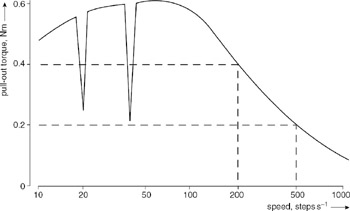
If a stepping motor is used to change the position of a mechanical load by several steps the system designer needs to know how much torque the motor can produce whilst accelerating, decelerating or running at constant speed. The motor must produce sufficient torque to overcome the load torque and accelerate the load inertia up to the maximum speed. The necessary information is supplied in the form of a graph known as the pull-out torque/speed characteristic showing the maximum torque which the motor can develop at each operating speed. This maximum torque is termed the pull-out torque because if the load torque exceeds this value the rotor is pulled out of synchronism with the magnetic field and the motor stalls. A typical pull-out torque/speed characteristic is shown in Fig. 4.1. In this case the motor would be able to drive a load torque of 0.2 Nm at all speeds up to 500 steps per second, because the pull-out torque exceeds the load torque over this speed range. However, for a load torque of 0.4 Nm the maximum operating speed would have to be limited to 200 steps per second and there would be additional problems in operating at speeds around 20 and 40 steps per second. For a given load the maximum operating speed is referred to as the pull-out rate, so in this example the pull-out rate for a load of 0.2 Nm is 500 steps per second.
The complete...