Stepping Motors: A Guide to Theory and Practice, Fourth Edition

Chapter 5: High-Speed Operation

5.1 Introduction

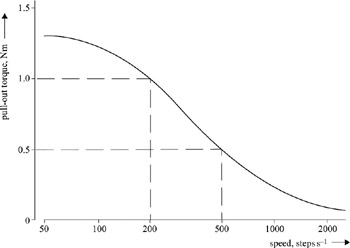
In many applications the motor must be able to produce a large pull-out torque over a wide range of stepping rates, so the time taken to position a load is minimised. For example, suppose a motor with the torque/speed characteristic shown in Fig. 5.1 has to move a load 1000 steps. If the load torque is 0.5 Nm then the pull-out rate is 500 steps per second and the load is positioned in ~1000/500=2 s. However, for a load torque of 1 Nm the maximum speed would have to be restricted to 200 steps per second and the positioning time would be 1000/200 = 5 s. Clearly the designer of the system with a load torque of 1 Nm would like to know what parameters of the motor and drive need to be changed so that a pull-out torque of 1 Nm is available at 500 steps per second.


Figure 5.1: Maximum operating speeds for different load torques

At high stepping rates each phase is excited for only a short time interval and the build-up time of the phase current is a significant proportion of the excitation interval. When a motor is operating at the highest speeds the current in each phase may not even reach its rated value before the excitation interval finishes and the phase is turned off. In addition the time taken for the phase current to decay becomes important at high speeds, because the phase current continues flowing (through the freewheeling diode) beyond the...

UNLIMITED FREE
ACCESS
TO THE WORLD'S BEST IDEAS

SUBMIT
Already a GlobalSpec user? Log in.

This is embarrasing...

An error occurred while processing the form. Please try again in a few minutes.

Customize Your GlobalSpec Experience

Category: Stepper Motors (rotary)
Finish!
Privacy Policy

This is embarrasing...

An error occurred while processing the form. Please try again in a few minutes.