Stepping Motors: A Guide to Theory and Practice, Fourth Edition
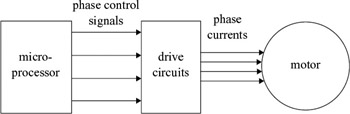
Stepping motors are often used as output devices for microprocessor-based control systems. The essential feature of these systems is that the microprocessor program produces a result and the stepping motor must then move the load to the position corresponding to this result . In this chapter we shall be considering the ways in which the microprocessor can be involved in control of the stepping motor. Figure 8.1, for example, shows an open-loop control system which would be termed software-intensive , because the microprocessor produces the phase control signals; the program is responsible for timing and sequencing the signals to move the motor to the required position. In complete contrast is the hardware-intensive system shown in Fig. 8.2. Here the microprocessor program merely feeds the target position information and a start command to the hardware controller, which generates the phase control signals for the motor drive circuits and a finish signal for the microprocessor when the target is reached.
When choosing between software- and hardware-intensive interfaces (or possibly attempting a compromise between the extremes depicted in Figs 8.1 and 8.2), the system designer has to consider several aspects of microprocessor and motor performance. It is immediately apparent from the preceding discussion that a control scheme based on the software approach is likely to involve a considerable commitment of processor capacity. If this capacity is already available, then the software-intensive approach can be adopted at little cost, as standard stepping motor control...