Stepping Motors: A Guide to Theory and Practice, Fourth Edition

5.3: Pull-out torque/speed characteristics for the variable-reluctance motor

5.3 Pull-out torque/speed characteristics for the variable-reluctance motor

5.3.1 Circuit representation of the motor

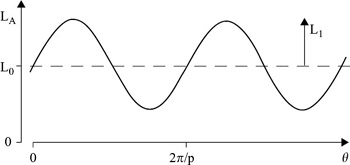
In the variable-reluctance stepping motor the voltages induced by the rotor motion are due to the variation of the phase inductance with rotor position. If the stator and rotor teeth of one phase are fully aligned the flux path has a low reluctance; for a given phase current a large flux links the windings, so the phase inductance is at its maximum value. Conversely when the teeth are completely misaligned the flux path has a high reluctance and the phase inductance is a minimum. The variation of phase inductance is approximately sinusoidal with a wavelength equal to the rotor tooth pitch, as shown in Fig. 5.10. For a motor with p rotor teeth the phase inductance can be written as


Figure 5.10: Variation of phase inductance with rotor position for a variable reluctance stepping motor

where L 0 is the average phase inductance and L 1 is the amplitude of the inductance variation with rotor position. These parameters may be specified by the manufacturer, but they can also be measured by the user if necessary (Kordik, 1975).

The complete excitation cycle for an n-phase motor consists of n steps, giving a total movement of one rotor tooth pitch (2 ?/ p). For a stepping rate f, the excitation frequency is f/n and therefore the angular frequency ? of the supply to one phase is

The average...

UNLIMITED FREE
ACCESS
TO THE WORLD'S BEST IDEAS

SUBMIT
Already a GlobalSpec user? Log in.

This is embarrasing...

An error occurred while processing the form. Please try again in a few minutes.

Customize Your GlobalSpec Experience

Category: Stepper Motors (rotary)
Finish!
Privacy Policy

This is embarrasing...

An error occurred while processing the form. Please try again in a few minutes.