Stepping Motors: A Guide to Theory and Practice, Fourth Edition

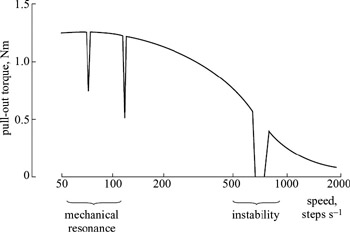
At high speeds the complete motor/drive system can become unstable, so that it is impossible to operate the system continuously in a certain stepping rate band. Experience has shown that the effects of the instability can be avoided if the system is accelerated briskly through the unstable region. Furthermore the effects are minimised in heavily loaded open-loop systems with substantial viscous damping and are completely avoided in closed-loop systems. The instability is often represented by dips in the steady-state pull-out torque/speed characteristics (Fig. 5.21), though it must be emphasised that, unlike the mechanical resonances described in Section 4.3, this instability is an electromagnetic effect which usually manifests itself at higher stepping rates.
The analysis of instability has been a subject of great academic interest for many years and a large number of publications, dealing with various system configurations, have appeared (e.g. Hughes and Lawrenson, 1979; Hesmondhalgh and Tipping, 1987; Pickup and Russell, 1987; Clarkson and Acarnley, 1988). It is fortunate for the stepping motor user that, after varying levels of tortuous analysis, all of these studies have agreed on some surprisingly simple results. The most important of these results is that the instability occurs close to those stepping rates where the angular frequency of the phase winding excitation is equal to the phase resistance ( R) divided by the phase winding inductance ( L). Thus, for the hybrid stepping motor which...