TCP/IP Explained

An easy to understand, comprehensive, and high-level introduction to TCP/IP.
 TABLE OF CONTENTS
 Like EGP discussed in the previous chapter, the Border Gateway Protocol (BGP) is used to exchange routing information between Autonomous Systems (ASs). BGP then is the latest member of the Exterior Gateway Protocol family. The classic definition of an Autonomous System is one that is under the control of a single administrative authority, uses a single, common, Interior Gateway Protocol (IGP), and a common set of metrics. Today, this definition no longer fits. Many Autonomous Systems now use several IGPs and several sets of metrics. However, provided that the AS appears to use a coherent routing policy, BGP can be used.
BGP has undergone many changes in recent years and, as such, it epitomizes the way in which the Internet community operates, with change being the only constant factor within the networking industry. Certainly it is true to say that, like EGP, few internets will require its use. Moreover, considering the potentially small operational base of the protocol, it is interesting to note that the current version is 4!
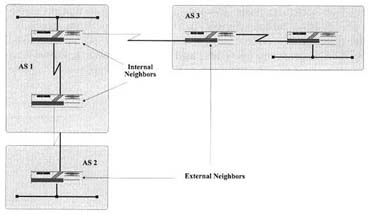
BGP version 4 is defined by RFC 1771, and with it several new definitions are used. BGP supports two neighbor types known as Internal and External. An Internal Neighbor resides in the same AS, while External Neighbors reside in other ASs. Figure 13-1 shows an example of Internal and External Neighbors in a BGP environment.
As in OSPF, a connection between two BGP devices residing in different AS's is referred to...