TCP/IP Explained

An easy to understand, comprehensive, and high-level introduction to TCP/IP.
 TABLE OF CONTENTS
 The Simple Mail Transfer Protocol (SMTP) as defined by RFC 821 serves to provide a reliable and efficient mail delivery service. In operation, as a result of a user mail request, the SMTP sender (the client) establishes a TCP connection with listener port 25 10 (l9 16) on a SMTP recipient (server). Then, through a defined set of commands/responses, transfers mail items to the receiver in much the same way as the FTP control channel. Unlike FTP however, all transactions take place over a single connection.
Where both the sender and recipient reside on the same network (or in the same domain), the sender establishes a direct connection with the receiving host as demonstrated Figure 18-1. Here, a user at the sending host requests a mail service to be established with the receiver and mail items are either delivered to remote mailbox(s) or directly to remote users if they are available.
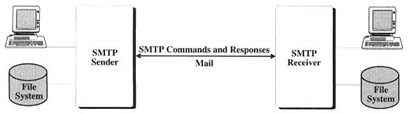
The delivery of such local mail is of course extremely necessary, however the strength of SMTP lies in its ability to deliver mail messages to any user on any cooperating machine globally. Where the sender is unable to directly deliver mail as in the example above, intermediate systems are employed that forward mail to the intended recipient(s). Indeed, we should be able to direct mail messages to any number of recipients on many systems as Figure 18-2 shows.
In this example, we see that a single user directs mail to...