TCP/IP Explained

An easy to understand, comprehensive, and high-level introduction to TCP/IP.
 TABLE OF CONTENTS
 Before looking at the Point-to-Point Protocol (PPP) in detail, let us first consider the dawn of time as far as IP remote connections are concerned. RFC 1055, the document defining SLIP is titled, " A non-standard for transmission of IP datagrams over serial lines," and this is possibly the best description of it. SLIP is a simple method of encapsulating IP Datagrams for transmission over serial lines, and provides nothing in terms of security, compression, protocol identification, or error detection. In all, although widely used, SLIP is merely a means of transporting IP Datagrams over these serial links.
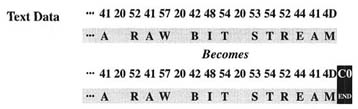
SLIP defines just two special characters to accomplish the task of encapsulation namely END and ESC (Escape). The END character is designated by the value C0 16 (192 10), and the ESC character by DB 16 (219 10). IP datagrams are then transmitted directly over the serial link and the END character is appended immediately at the end of the packet as Figure 22-2 shows.
Some implementations differ slightly in that the END character is used as both a start and end delimiter. This means that immediately prior to transmitting the packet, we send an END. Spurious characters that have been received as a result of line noise are therefore rejected by the receiver without the need to reject the following packet.
For example, where we have no spurious characters, the receiver merely receives two...