Thermoplastics and Thermoplastic Composites: Technical Information for Plastics Users
Polymers have some specific properties due to their organic nature. Thermoplastics, as seen in Chapter 1, are independent organic macromolecules with some sensitivity to environmental parameters: temperature, moisture, deleterious solids, liquids, gases and other chemical products. They are also sensitive to mechanical loading, especially cyclic loads. Their specific properties, such as electrical or optical properties, are also important for their applications.
All the properties are influenced by the additives used with the thermoplastic matrices, notably the reinforcements but also stabilizers, plasticizers, colorants and others.
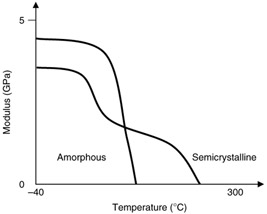
Thermomechanical behaviour is most probably the most widely exploited property of engineering thermoplastics. Figure 3.1 shows the behaviour of two types of thermoplastic, one amorphous and the other semicrystalline, versus temperature. We can see several steps moving from low to high temperatures:
a high modulus plateau corresponding to a brittle material
a first decrease of the modulus that depends on the material morphology:
leading to a ductile state for the amorphous material
leading to a second pseudo-plateau for the semicrystalline thermoplastic
a final drop for the semicrystalline material.
This is important for the majority of applications because:
the softening at 'high' temperature limits the mechanical performances
the brittleness at 'low' temperature can lead to failure after light impacts
the damping properties broadly vary with temperature and become weaker or nonexistent at low temperatures.
The selection of thermoplastics and composites to design a new part requires impartial and comparative testing methods.