Thermoplastics and Thermoplastic Composites: Technical Information for Plastics Users
Several acronyms are used for different PVCs:
S-PVC for suspension PVC
E-PVC for emulsion PVC
M-PVC for mass or bulk PVC
PVC-U for unplasticized PVC
PVC-P for plasticized PVC
PVC-HI for high impact PVC
PVC-C or CPVC for chlorinated PVC (see Section 4.7).
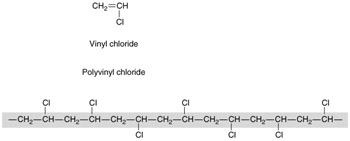
Pure PVC is the linear homopolymer of vinyl chloride, as we can see in Figure 4.32. The industrial polymers are amorphous with a backbone identical to those of polyethylene, polypropylene and polybutene but the pendant chlorine atoms result in a polar polymer. The theoretical chlorine content is roughly 57%.
PVC can be polymerized, possibly with a comonomer (mainly vinyl acetate):
In an emulsion, the oldest process. The presence of emulsifiers at a greater or lesser level gives a variable haze to the finished articles, eases the processing, decreases the electrostatic build-up, and increases the absorption of water. E-PVC, dispersion PVC or PVC pastes are used to make plastisols and organosols.
In suspension. This process gives transparent parts, good electrical properties and a weak absorption of water.
In bulk. PVC is free from additives such as protective emulsifiers, dispersants or colloids, which makes it possible to obtain parts that are even more transparent and glossy than suspension PVC.
In solution. Today this technique is obsolete.
The property sets of raw PVCs as-polymerized are generally unsuitable for the range of intended applications. It is essential to upgrade and customize the raw polymers by compounding to satisfy the requirements...