Thermoplastics and Thermoplastic Composites: Technical Information for Plastics Users
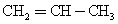
From the simple chemical formula of propylene
are born several subfamilies according to the polymerization process, the use of comonomers, blending with elastomers, and the use of reinforcements:
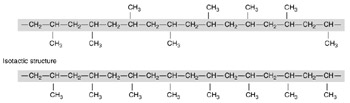
Homopolymers, by polymerization of propylene alone. Two basic structures can be obtained (Figure 4.7):
isotactic with the CH 3 located on only one side of the backbone. This is the only form used for engineering applications
atactic with the CH 3 randomly located here and there on either side of the backbone. This form is not used as an engineering material but has some applications such as bitumen modifiers for roofing.
The homopolymers are rigid but rather brittle.
Copolymers, by polymerization of propylene with another olefin, ethylene being the most used. These copolymers can have:
a random structure with the comonomer randomly inserted into the backbone, which induces an amorphous morphology and therefore a better transparency
a block structure with several comonomer sequences inserted into polypropylene sequences, which favours crystallinity.
The copolymers have better behaviour at low temperature and are more impact resistant but less rigid than the homopolymers. The copolymer blocks present a good balance between rigidity and impact strength that depends on the importance of the blocks and their distribution:
modified ethylene-propylene elastomers, which confer very high impact strengths even at low temperature.
reinforcement: mineral fillers, especially talcs, and glass fibres are used to increase rigidity at ambient and higher temperatures, as well...