Thermoplastics and Thermoplastic Composites: Technical Information for Plastics Users
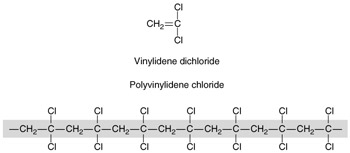
Polyvinylidene chloride is produced by polymerization of vinylidene dichloride, as shown in Figure 4.38. The chlorine content can be as high as 73% versus 57% for PVCs.
In fact, only copolymers are industrialized, often with PVC in a minor percentage. The main interest is its excellent impermeability to water vapour and gases, suiting PVDC for the packaging industry.
PVDC is appreciated for its barrier effect to water vapour, gases and aromas as well as its chemical resistance (except to certain solvents), its relative flexibility, fireproofing, the possibility of food contact for special grades, transparency, gloss, sealability (including by high frequency and ultrasound), printability.
PVDC is currently handicapped by the ecological problems associated with chlorine, the limited number of producers, its cost, limited resistance to light and some organic chemicals such as aromatic hydrocarbons, ketones etc., impact sensitivity the more so as the temperature decreases, high density, fume toxicity and corrosivity in the event of fire.
PVDC is a speciality polymer produced in a limited range of grades with different copolymers and additives targeting barrier effects for packaging, coating and co-extrusion. Latices are marketed for the coating of other polymers or papers.
The cost is higher than for PVC.
(See Chapter 2 for further information.)
Applications are far fewer than for PVC, mainly targeting:
packaging
barrier films for food, pharmaceuticals, chemicals
barrier layer in multilayer films or sheets, and coatings...