4.4.1 Ethylene-Vinyl Acetate Copolymers (EVA, E/VAC, EVAC, VAE, EVM)
In the following, we will generally use the acronyms:
-
EVA, which is the most commonly used for ethylene-vinyl acetate copolymers, instead of the standardized acronym E/VAC (ISO 1043). VAE is sometimes used for high VA contents
-
VA for vinyl acetate content.
EVM is the standardized acronym for ethylene-vinyl acetate rubbers (ISO 1629).
EVA and VAE (see Figure 4.24) are copolymerized from ethylene and vinyl acetate that is randomly distributed along the backbone. The backbone is identical to that of the polyolefins but the pendant groups are different, with a polar character and a random structure that decreases crystallinity the more so as the vinyl acetate level rises.
 Figure 4.24: Vinyl acetate, ethylene and ethylene-vinylacetate copolymer formulae
 The properties depend on the vinyl acetate level, the crystallinity (see Figure 4.25), the branching level, the molecular weight and the polarity.
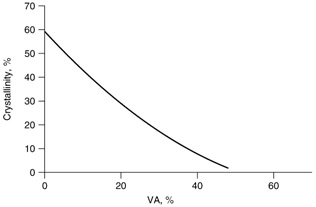 Figure 4.25: Neat EVA examples of crystallinity (%) versus VA content (%)
 Figure 4.25 displays examples of crystallinity (%) versus vinyl acetate content (%) for neat EVA. Note the progressive and fast fall in the crystallinity.
Copolymers with low vinyl acetate content (ca. 2 10%) have properties close to those of low-density polyethylene.
When the vinyl acetate content rises, polarity increases, and crystallinity and hardness decrease. For a 40 50% vinyl acetate content, the copolymer is an amorphous resin that is easily crosslinkable.
Resins with high vinyl acetate content (ca. 60 90%) are very often emulsions or dispersions in water used for...

 TABLE OF CONTENTS