Trusted Computing
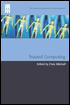
Including application examples which are based on recent and ongoing research, this book introduces recent technological developments in trusted computing, and surveys the various current approaches to providing trusted platforms.
 TABLE OF CONTENTS
 Recent interest in the area of trusted computing has led to a great deal of discourse regarding the precise meaning of trust in the context of trusted computing. Trusted computing has become a term defined by many.
As highlighted by Anderson [2], there are subtle differences between a system which is considered trusted, and a trustworthy system. That is:
a trusted system or component is defined as one whose failure can break the security policy [3]; and
a trustworthy system or component is defined as one that will not fail [3].
From examination of work undertaken by a variety of trusted computing projects, it becomes apparent, however, that the term trusted computing is usually used in a sense consistent with the following definition, as given by the TCG:
a trusted system or component is one that behaves in the expected manner for a particular purpose.
The concept of trust has been explored in greater depth by Balacheff et al. [4], who chose to classify TP components into two groups, those that satisfy the behavioural definition of trust and those that fulfil the social definition of trust.
Behavioural trust is dynamic:
it provides a means of knowing whether a platform can be trusted; and
it results from the dynamic collection of behavioural evidence.
Conversely, social trust is static:
it provides a means of knowing whether a platform should be trusted; and also
provides evidence as to whether a platform is...