Trusted Computing
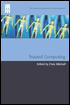
Including application examples which are based on recent and ongoing research, this book introduces recent technological developments in trusted computing, and surveys the various current approaches to providing trusted platforms.
 TABLE OF CONTENTS
 Following the description of NGSCB, we briefly examine LT, born out of Intel's initiative to address the challenges of trusted computing. LaGrande is defined as a set of enhanced hardware components designed to help protect sensitive information from software-based attacks, where LT features include capabilities in the microprocessor, chipset, I/O subsystems, and other platform components' [26]. As was the case with NGSCB, detailed information on LT remains limited.
LaGrande Technology essentially provides all the components needed to meet the requirements defined by Microsoft for hardware enhancements and extensions necessary to support their NGSCB architecture.
The generic LT architecture consists of two fundamental concepts. These are the notions of standard and protected partitions, and the domain manager.
The standard partition provides an environment identical to today's Intel Architecture-32 (IA-32) environment [26]. In this standard partition, users may freely run software of their choice. The existence of this standard partition implies that, despite the addition of supplementary security mechanisms to the platform, code already in existence will retain its value, and software unconcerned with security will have somewhere to execute unaffected.
The protected partition provides a parallel environment, in which hardened software can be executed with the assurance that it cannot be tampered with by software executing in either the standard or protected partition. This protected partition is hardened against software attacks by the implementation of a number of components, described below, which provide domain separation; memory protection; protected graphics; and a trusted...