Trusted Computing
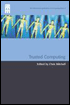
Including application examples which are based on recent and ongoing research, this book introduces recent technological developments in trusted computing, and surveys the various current approaches to providing trusted platforms.
 TABLE OF CONTENTS
 In June 2002 [22], Microsoft released information on Palladium, a system which combined software and hardware controls to create a Trusted Computing Platform (TCP). It was initially stated that Palladium was due to be shipped with the next major version of Windows, the Longhorn OS, then planned for release in 2004.
The name Palladium , however, has since been abandoned in favour of NGSCB. According to John Lettice of the Register [23], this change was made for two fundamental reasons: the name Palladium had already been used for another product, and because of the initial controversy and misdirected criticism surrounding the project. To date, however, few technical details regarding Palladium or NGSCB have been published. Primary reference material used in the writing of this chapter includes References [6], [7], [24] and [25]. Certain details of Microsoft's NGSCB are explored in Chapter 4.
Microsoft was one of the founding members of the TCG and actively participates in the organisation [4]. The version 1.1 TPM is, however, not supported by Microsoft Windows, nor will it be used as the basis of NGSCB functionality. Version 1.1 TPMs may be supported on a Microsoft windows machine with addition of a Cryptographic Service Provider (CSP), provided by the hardware manufacturer, which has been written to support the Windows Cryptographic Applications Programming Interface (CAPI). [3] The TPM, as defined in version 1.2 of the specifications, is, however,...