Trusted Computing
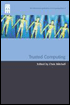
Including application examples which are based on recent and ongoing research, this book introduces recent technological developments in trusted computing, and surveys the various current approaches to providing trusted platforms.
 TABLE OF CONTENTS
 At the current time, the number of applications that use trusted computing (TC) is quite limited, both in volume and in scope. For now and probably the near future as well these applications focus on the business world, and are mainly part of large scale, integrated security solutions, such as virtual private networks (VPNs). One can expect a number of new applications that support the management of large networks, for example, to automatically verify that all machines have a proper patch level or only contain company authorised software, to maintain control over signature and encryption keys, etc. As TC technology exists on the lowest hardware level of the computer, it has to be further supported by higher-level functionality such as the operating system before mainstream applications can fully profit from the concept. [1] Thus, outside of such applications and those that use cryptography anyway, little use will be made of TC in the near future.
The candidate application that always did (and still does) most commonly appear in the press and various Internet discussions is the use of TC for Digital Rights Management (DRM), that is, the option to attach a policy to a piece of data and remotely enforce this policy. While research in this area is becoming rather active, the author is not aware of any attempts to use Trusted Computing Group (TCG) technology to this end on a Personal Computer (PC) platform. It is debatable if the TC...