UV Coatings: Basics, Recent Developments and New Applications
Coatings are found almost anywhere in daily life, the most prominent examples are architectural wall coatings and automotive paints. They are applied in order to provide:
decorative appearance, and/or
protective barrier.
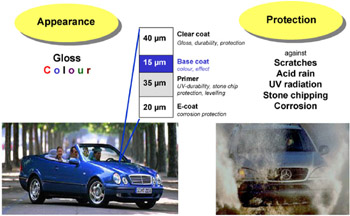
The main functions of a coating are thus on the one hand to ensure the desired appearance (colour, gloss) and on the other hand the necessary protection, against corrosion, stone chipping, scratches, abrasion or chemical attack, like red wine, coffee or mustard on furniture coatings or acid rain, tree resins or bird excrements on automotive coatings, as shown in Figure 1.1.
Whereas the do-it-yourself architectural coatings are almost all water-based, the vast majority of industrially used coatings, applied in factories on various substrates, like vehicles, furniture, metal cans, paperboards, etc., still contain solvents.
The coatings and application spectrum discussed in this book are predominantly based on the industrial coatings sector, which had a share of about 40% of the whole worldwide coatings market (60% architectural).
The market prospects of future coating technologies in the industrial paint sector are reflecting the environmental concerns about the use of solvents, and hence governed by VOC (volatile organic carbon) regulations. According to these regulations, the market share of solvent-based coatings is declining significantly and the share of alternative, environmentally friendly systems, especially water-based, powder, and radiation curable (UV/electronbeam) coatings is steadily increasing, as depicted in the chart in Figure 1.2 (Paulus, reported at RadTech Conference,...