UV Coatings: Basics, Recent Developments and New Applications
Chapter 9: Recent Developments

9.1 CHEMISTRY RELATED DEVELOPMENTS

9.1.1 Solvent-Borne UV Coatings

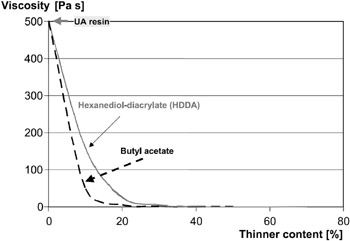
Typical UV-curable coatings do not contain any solvents and are often therefore called 100% solids systems, although they are liquid in the uncured state. They are composed of low molecular weight resins and monomeric reactive diluents, which take over the function of reducing viscosity instead of traditionally used solvents. However, the use of solvents is not strictly forbidden. In case of spray applications the viscosity of the coatings has to be very low ( <500 mPa s). Therefore solvents may be used instead of monomers, since monomer spraying mist may cause pollution and toxicological problems. The thinning power of solvents is similar to that of the reactive diluents (Figure 9.1). With less than 20% solvents (thus very high solids systems) viscosities can be reduced to the range required for spray application. This low viscosity is due to the relatively low molecular weight of the resins used. Furthermore, solvents as thinners may be used for UV primer applications, since the preferred very thin layers are obtained with very low viscosities or low solids contents. Solvents may also help to improve adhesion, especially to plastics, where they are able to swell the surface and facilitate interpenetration.


FIG. 9.1: Thinning power of butyl acetate compared to HDDA for a urethane acrylate resin.

9.1.2 Water-Based UV Coatings

The use of aqueous binder emulsions for radiation-curing coatings has increased within the last 20 years. A technology that began with aqueous emulsions based on unsaturated polyesters, polyester...

UNLIMITED FREE
ACCESS
TO THE WORLD'S BEST IDEAS

SUBMIT
Already a GlobalSpec user? Log in.

This is embarrasing...

An error occurred while processing the form. Please try again in a few minutes.

Customize Your GlobalSpec Experience

Category: Organic Solvents
Finish!
Privacy Policy

This is embarrasing...

An error occurred while processing the form. Please try again in a few minutes.