UV Coatings: Basics, Recent Developments and New Applications
The most important intrinsic drawbacks of the radically induced radiation curing technology together with proposed and practiced solutions to overcome these disadvantages are summarized in this chapter. Two of these drawbacks are related to the radical intermediates itself, which firstly hamper the curing reaction at the surface ( oxygen inhibition) and secondly contribute to yellowing ( initial yellowing), until they are completely decayed. The third main drawback is associated with the lack of radical formation in areas to which the light does not penetrate ( shadow areas) and therefore no curing occurs.
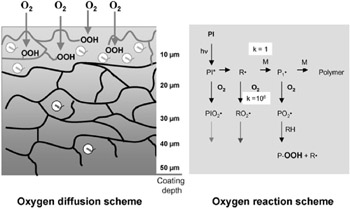
The reaction of oxygen with the different species formed during the photopolymerisation and the effects on the network formation throughout the film thickness of a coating are sketched in Figure 7.1. The termination of the reaction by hydroperoxides, the incomplete network formation at the surface and the remaining acrylate double bonds are commonly called the problem of oxygen inhibition .
In the photoinduced radical polymerization of multifunctional monomers, the efficiency of crosslinking is due to the efficiency of the propagation step. In the presence of air, the oxygen diradical reacts much faster with the photoinitiator or propagating radical to form a relatively stable peroxy-radical,1 which does not initiate the acrylate polymerization, but rather acts as an inhibitor. This inhibition results in an induction period of the polymerization until all oxygen is consumed.2 Therefore, in thin films the complete polymerization is retarded...