UV Coatings: Basics, Recent Developments and New Applications
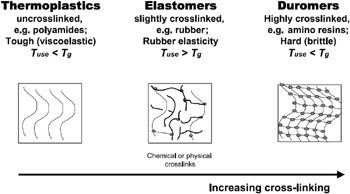
In the year 2000 about 180 mln. tons of polymers were sold, whereof about 30 mln. tons are coatings (lacquers), glues and dispersions. According to their functions and structures these polymers can be classified into different categories, for instance, natural (proteins, polysaccharides, rubber) and synthetic polymers (thermoplastics, elastomers, duromers). The main group of synthetic polymers belongs to the class of thermoplastics and fibres, which are linear, uncrosslinked polymers, which can be processed into different shapes by thermal treatment. Besides other classifications, one classification of the synthetic polymer types can be done by the increasing degree of crosslinking, whereof the elastomers are slightly or moderately crosslinked, occurring very often as rubber-like flexible materials, and duromers, which are highly crosslinked, available for instance as hard coating materials on kitchen worktops, on cars or on industrially produced parquet floorings (Figure 3.1).
This type of classification however reflects only the structural composition, whereas the names of the different classes (thermoplastic, elastomer, duromers) reflect the mechanical behavior of the polymer classes at the normal temperatures of use. Thermoplastics appear at room temperature in a glassy state, but become plastic upon heating at temperatures above the so-called glass transition temperature, the elastomers are used at temperatures above their glass transition and therefore are elastic at room temperature, and, finally, the duromers are very durable and exhibit extraordinary mechanical properties. The mechanical properties of materials are those properties that involve a reaction to an applied stress...