UV Coatings: Basics, Recent Developments and New Applications

4.1: RADICAL POLYMERIZATION SYSTEMS

4.1 RADICAL POLYMERIZATION SYSTEMS

4.1.1 Standard Resins

4.1.1.1 Unsaturated polyesters

The unsaturated polyesters were the first class of resins used in UV curing, now their overwhelming use is in fibre reinforced composites and only a small fraction is used in UV curable laminating adhesives and wood fillers. Such unsaturated polyesters (UPE), derived by the condensation reaction of maleic or fumaric acid with various diols, dissolved in styrene, were the earliest used UV curable resins. Because of the toxicity of styrene, these systems are not used extensively any more. Multifunctional acrylates, like TPGDA or TMPTA, have been used instead of styrene as a reactive diluent in UPE resins for adhesives and ink applications. Recently, powder resins based on unsaturated polyesters have been introduced, obtained by mixtures of UPE with vinyl ether polyurethane crosslinkers2 or mixtures of UPE with allyl ether polyesters.3

4.1.1.2 Standard acrylate terminated oligomers

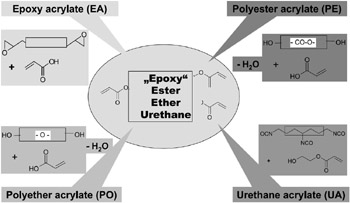
The acrylate resins now dominate the market. The schematic structure of the main acrylate terminated resin classes is shown in Figure 4.2.


FIG. 4.2: Schematic chemical structure of main acrylate resin types for acrylate based radically curing UV coatings.

From the resin classes the epoxy acrylates are the biggest on the market, prepared by the reaction of epoxides, e.g., Bisphenol-A diglycidylether, with acrylic acid (Figure 4.3). These Bisphenol-A type acrylated epoxides are the dominant products on the market and account for about 70% of all epoxy acrylates used. Phenol-formaldehyde resin based (Novolac)-glycidylethers acrylates are used as a speciality in solder film resists, because ...

UNLIMITED FREE
ACCESS
TO THE WORLD'S BEST IDEAS

SUBMIT
Already a GlobalSpec user? Log in.

This is embarrasing...

An error occurred while processing the form. Please try again in a few minutes.

Customize Your GlobalSpec Experience

Category: Acrylic Adhesives and Acrylate Adhesives
Finish!
Privacy Policy

This is embarrasing...

An error occurred while processing the form. Please try again in a few minutes.