UV Coatings: Basics, Recent Developments and New Applications

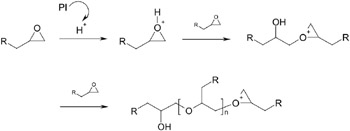
Interest and research activity in cationic UV curing has increased due to the insensitivity to oxygen inhibition. Until now this technology has not yet found the widespread use in many industrial applications compared to radical systems. Decorative and protective coatings, printing inks and adhesives are just a few examples of applications in which photoinitiated cationic polymerizations have experienced the most commercial growth.53 As with radically polymerizing UV coatings, the cationic curing is also a very rapid polymerization consuming little energy without the need for an inert atmosphere, hence providing important economic incentives. The cationic polymerization process is shown schematically on the example of epoxide polymerization (4.2.1). A proton or a Lewis acid activates the oxygen atom in order to facilitate a nucleophilic attack of epoxide oxygen onto the (posi-tivated) carbon next to the activated oxygen. Upon ring opening a secondary hydroxide is formed and the chain reaction continues at the next activated oxirane ring.
| (4.2.1) | ![]() |
The thermal, mechanical, chemical resistance, low shrinkage and adhesion characteristics of the network polymers that are formed are excellent. However, their limited use up to now may be due to other problems of the cationic polymerization system than oxygen inhibition; for example, moisture can terminate the chain reaction. The industrial impact of cationic UV curing is predicted to increase markedly in the future as this technology undergoes further maturation.54
In general, two main groups of monomers are used in cationic polymerization, the first being ethylenic monomers...