Valve Selection Handbook: Engineering Fundamentals for Selecting the Right Valve Design for Every Industrial Flow Application, Fifth Edition
PARALLEL GATE VALVES

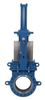
Parallel gate valves are slide valves with a parallel-faced gate-like closure member. This closure member may consist of a single disc or twin discs with a spreading mechanism in between. Typical valves of this type are shown in Figure 3-25 through Figure 3-32.


Figure 3-25: Parallel Slide Gate Valve with Converging-Diverging Flow Passage and Follower Eyepiece. ( Courtesy of Hopkinsons Limited.)

The force that presses the disc against the seat is controlled by the fluid pressure acting on either a floating disc or a floating seat. In the case of twin disc parallel gate valves, this force may be supplemented with a mechanical force from a spreading mechanism between the discs.

One advantage of parallel gate valves is their low resistance to flow, which in the case of full-bore valves approaches that of a short length of straight pipe. Because the disc slides across the seat face, parallel gate valves are also capable of handling fluids, which carry solids in suspension. This mode of valve operation also imposes some limitations on the use of parallel gate valves:

  • If fluid pressure is low, the seating force may be insufficient to produce a satisfactory seal between metal-to-metal seatings.

  • Frequent valve operation may lead to excessive wear of the seating faces, depending on magnitude of fluid pressure, width of seating faces, lubricity of the fluid to be sealed, and the wear resistance of the seating material. For this reason, parallel gate valves are normally used for infrequent valve operation...

UNLIMITED FREE
ACCESS
TO THE WORLD'S BEST IDEAS

SUBMIT
Already a GlobalSpec user? Log in.

This is embarrasing...

An error occurred while processing the form. Please try again in a few minutes.

Customize Your GlobalSpec Experience

Category: Gate Valves
Finish!
Privacy Policy

This is embarrasing...

An error occurred while processing the form. Please try again in a few minutes.