Valve Selection Handbook: Engineering Fundamentals for Selecting the Right Valve Design for Every Industrial Flow Application, Fifth Edition

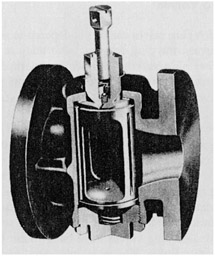
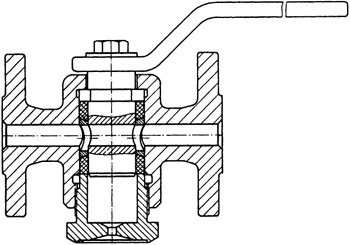
Plug valves are rotary valves in which a plug-shaped closure member is rotated through increments of 90 to engage or disengage a porthole or holes in the plug with the ports in the valve body. The shape of the plug may thereby be cylindrical, as in the valves shown in Figure 3-49 through Figure 3-53, or tapered, as in the valves shown in Figure 3-54 through Figure 3-58. Rotary valves with ball-shaped plugs are likewise members of the plug valve family, but are conventionally referred to as ball valves. These valves are discussed separately on page 108.
The shape of the port is commonly rectangular in parallel plugs, and truncated triangular shapes in taper plugs. These shapes permit a slimmer valve construction of reduced weight, but at the expense of some pressure drop. Full area round-bore ports are normally used only if the pipeline has to be scraped or the nature of the fluid demands a full area round bore. However, some plug valves are made only with round-bore because of the method of sealing employed.
Plug valves are best suited for stopping and starting flow and flow diversion, though they are also used occasionally for moderate throttling, depending on the nature of the service and the erosion-resistance of the seatings. Because the seatings move against each other with a...