Valve Selection Handbook: Engineering Fundamentals for Selecting the Right Valve Design for Every Industrial Flow Application, Fifth Edition
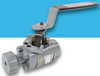
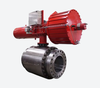
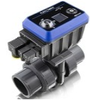
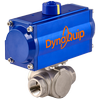
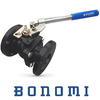
Ball valves are a species of plug valves having a ball-shaped closure member. The seat matching the ball is circular so that the seating stress is circumferentially uniform. Most ball valves are also equipped with soft seats that conform readily to the surface of the ball. Thus, from the point of sealing, the concept of the ball valve is excellent. The valves shown in Figure 3-60 through Figure 3-66 are typical of the ball valves available.
The flow-control characteristic that arises from a round port moving across a circular seat and from the double pressure drop across the two seats is very good. However, if the valve is left partially open for an extended period under conditions of a high pressure drop across the ball, the soft seat will tend to flow around the edge of the ball orifice and possibly lock the ball in that position. Ball valves for manual control are therefore best suited for stopping and starting flow and moderate throttling. If flow control is automatic, the ball is continuously on the move, thus keeping this failure from normally occurring.
Because the ball moves across the seats with a wiping motion, ball valves will handle fluids with solids in suspension. However, abrasive solids will damage the seats and the ball surface. Long, tough fibrous material may also present a problem, as the fibers tend to wrap around the ball.
To economize in the valve construction, most ball valves have a reduced bore with a venturi-shaped...