Elements of Spacecraft Design

Chapter 1: Introduction

1.1 First Spacecraft

The first spacecraft was a publicity stunt. At the conclusion of World War II, the United States and the USSR eyed each other across a destroyed Europe, neither trusting the other, both holding the recipe for the atomic bomb. It was clear, from captured German work, that it was feasible to design a ballistic missile capable of delivering the bomb anywhere in the world. It was also clear that if the USSR were first to have the capability, they could destroy the United States in a few hours without any possibility of retaliation during the "missile gap" before we finished our development. Both nations strained to develop the first intercontinental missile capability, and the USSR was first to have it. They could not just call the president and say "We've got it." They decided instead to make the announcement in a very dramatic way. It turns out that if you can put a given-size bomb on an intercontinental trajectory, you can put almost that much mass into low Earth orbit.

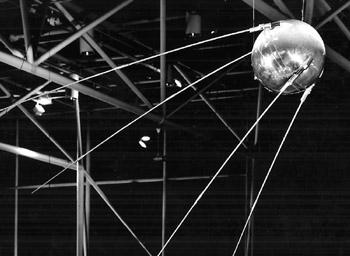
The USSR announced their intercontinental missile capability to the world on 4 October 1957 by launching the world's first spacecraft, Sputnik I, into low Earth orbit. The impact of Sputnik (Fig. 1.1), on public opinion was immense. The airspace over the continental United States was never penetrated during World War II despite the efforts of the two largest air forces ever assembled. Now Sputnik cut through our airspace with impunity every 90 min.


Figure 1.1: Replica of...

UNLIMITED FREE
ACCESS
TO THE WORLD'S BEST IDEAS

SUBMIT
Already a GlobalSpec user? Log in.

This is embarrasing...

An error occurred while processing the form. Please try again in a few minutes.

Customize Your GlobalSpec Experience

Category: Satellites
Finish!
Privacy Policy

This is embarrasing...

An error occurred while processing the form. Please try again in a few minutes.